Our AI-driven products are built to solve real-world challenges — continuously evolving to meet the changing demands of modern businesses.

MessageFlex

your all-in-one omni-channel platform for smart messaging and human-like voice engagement.

FinBridge leverages AI and ML to streamline operations and support modern banks, fintechs, and financial service providers.

Explore our dynamic portfolio, continuously evolving with cutting edge AI solutions to meet the ever changing needs of our clients.

Driving Progress & Innovation in Technology

Reimagining Possibilities Across Industries

Quantum in Financial Services

Why Quantum Computing Matters for Financial Services

Februrary, 19, 2026

100%
PQC Migration Progress
---
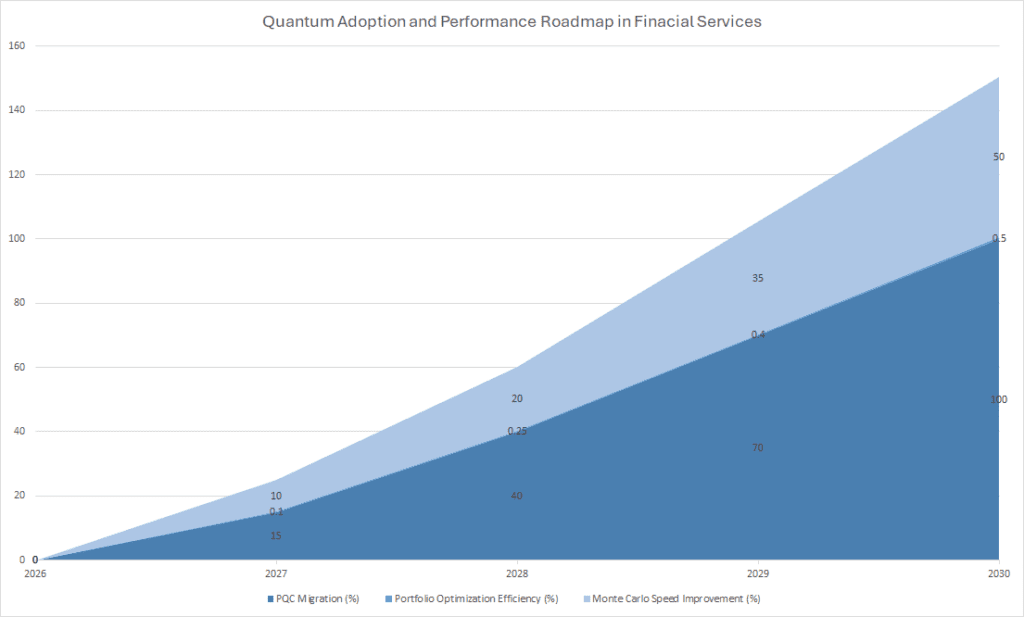
Track the yearly upgrade of critical systems to post-quantum cryptography, ensuring future-proof security. 100% – Full post-quantum cryptography readiness achieved by 2030.
0.5%
Portfolio Optimization Efficiency
---
Measure improvements in investment allocation using hybrid quantum-classical optimization methods.
50%
Monte Carlo Simulation Speed Improvement
---
See how quantum-inspired techniques accelerate risk and derivative simulations for faster decision-making.
100%
Quantum Governance & Readiness Implementation
---
Monitor adoption of governance frameworks and monitoring structures to stay quantum-ready. Complete adoption of governance frameworks and monitoring structures by 2030.

Progress of Quantum Readiness and Efficiency in Financial Services

This chart illustrates the projected adoption and impact of quantum computing in financial services from 2026 to 2030. It shows three key trends: the gradual migration of critical systems to post-quantum cryptography (PQC) to safeguard against future quantum threats, the incremental improvement in portfolio optimization efficiency using quantum-inspired methods, and the acceleration of Monte Carlo risk simulations through hybrid quantum-classical approaches. Together, these lines demonstrate how early investment in quantum readiness and experimentation can compound over time, improving security, operational efficiency, and risk management capabilities by 2030.

Why Quantum Computing Matters for Financial Services

Quantum computing presents both systemic risk and strategic opportunity for financial institutions.

Two realities are now well established in the literature

  1. Quantum algorithms such as Shor’s algorithm demonstrate that sufficiently large quantum systems could break widely deployed public-key cryptography schemes (RSA, ECC).

  2. Quantum algorithms including amplitude estimation and quantum approximate optimization show theoretical speedups for Monte Carlo simulation and constrained optimization problems relevant to financial services.

Cryptographic Risk: The Regulatory Imperative

The Quantum Threat to Public-Key Infrastructure

Shor’s algorithm proves that integer factorization and discrete logarithm problems can be solved in polynomial time on a fault-tolerant quantum computer.

Primary exposure areas

  • Digital signatures

  • TLS communications

  • Blockchain systems

  • Interbank settlement systems

Efforts to transition to authoritative standards are underway under the Post-Quantum Cryptography (PQC) project, led by the National Institute of Standards and Technology (NIST). The project finalized its first PQC algorithm selections between 2022 and 2024, including Kyber and Dilithium, both lattice-based algorithms.

Regulatory implication:

Financial institutions must begin migration planning now due to:

  • “Harvest now, decrypt later” risks

  • Long-term data confidentiality exposure

  • Infrastructure upgrade lead times

Optimizing Portfolios with Quantum Methods

Quantum computing is being explored as a way to improve investment decision-making. Recent research (2022–2024) shows that quantum algorithms like QAOA and Variational Quantum Algorithms (VQE), as well as hybrid classical-quantum approaches, could help with

  • Selecting the best mix of investments (mean-variance optimization)

  • Handling portfolio limits (cardinality constraints)

  • Accounting for trading costs

These methods are still in proof-of-concept research. They are promising for complex, high-dimensional portfolios, but full commercial adoption is not yet realized.

Faster Risk Simulations with Quantum Methods

Monte Carlo simulations are widely used in finance to estimate portfolio risk, extreme losses, and derivative pricing. Quantum methods, particularly quantum amplitude estimation, could reduce the number of calculations needed, speeding up these analyses.

Applications include:

  • Value at Risk (VaR)

  • Expected Shortfall (ES)

  • Counterparty Credit Risk

  • Derivative pricing

Key point: Current quantum hardware (NISQ devices) cannot yet deliver full speedups, so hybrid classical-quantum approaches are used in research experiments.

Industry Forecasts: Economic Impact

Market Size Projections

According to published research by McKinsey & Company (2023–2024 quantum outlook reports)

  • Quantum computing could generate $0.9–$1.3 trillion in value globally by 2035 across sectors.

  • Financial services are identified as one of the top early-value sectors due to optimization and risk modeling intensity.

Research from Boston Consulting Group estimates

  • Quantum computing market size could reach $90B+ by 2040.

  • Early enterprise experimentation phase expected between 2025–2030.

These are forward-looking projections, not guaranteed realized outcomes.

The Road Ahead: 2026–2030 Regulatory Roadmap

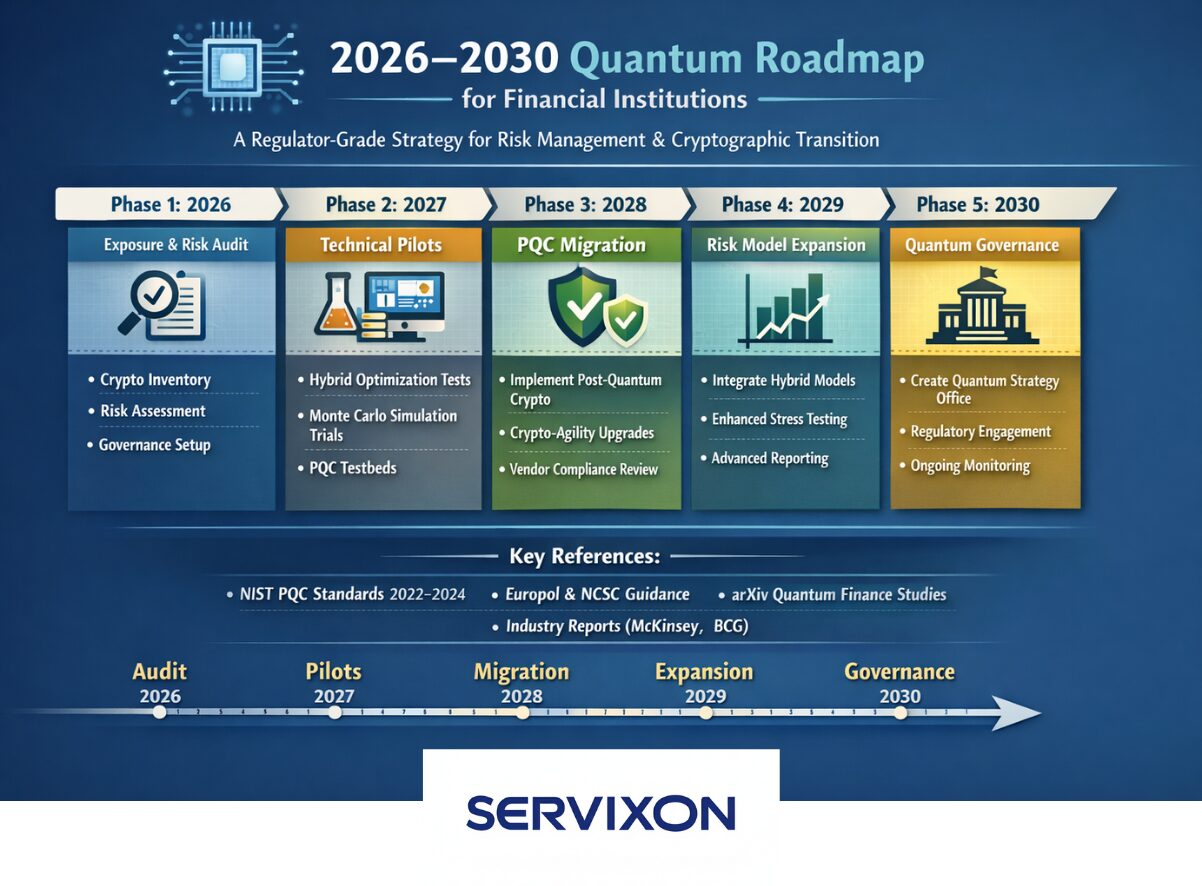
Figure: Quantum Crypto Saftey Roadmap

Phase 1 — 2026: Exposure & Risk Assesment

What to do

  • Conduct detailed enterprise cryptography inventories and mapping of RSA/ECC dependencies to identify future vulnerability exposures.

  • Review long-lived systems and data to classify potential quantum risk based on data shelf life and system lifetime.

  • Establish a governance committee to monitor quantum computing developments and drive readiness planning.

Why this matters
European and global authorities now urge the financial sector to begin evaluating quantum cryptographic threats today — citing the risk of adversaries collecting encrypted data now to decrypt later once quantum computers advance.

Deliverable
Formal Quantum Risk Register documenting systems at risk and planned mitigation steps.


Phase 2 — 2027: Controlled Technical Piolts

What to do

  • Launch hybrid optimization sandbox projects to test quantum‑inspired techniques on selected high complexity problems (e.g., portfolio optimization, derivatives modelling).

  • Begin benchmarking scenarios for Monte Carlo acceleration using hybrid quantum‑classical methods.

  • Establish baseline post‑quantum cryptography (PQC) testbeds to begin evaluating candidate PQC algorithms and tools.

Supporting research
Academic and industry literature highlight near‑term hybrid quantum‑classical approaches as the most realistic path to extract value from quantum computing capabilities before full fault‑tolerant machines arrive.

Deliverable
Pilot evaluation report suitable for internal oversight and eventual regulatory disclosure.

Phase 3 — 2028: Post‑Quantum Cryptography Transition Begins

What to do

  • Start phasing in PQC for critical systems — especially those protected by RSA or ECC encryption.

  • Implement crypto‑agility architectures that enable future algorithm switching with minimal disruption.

  • Conduct vendor compliance reviews to ensure third‑party products support PQC readiness.

Research & policy context
Government and industry guidance, including NIST’s PQC initiative and global security advisories, recommend investing in PQC and crypto‑agility now due to long lead times and the risk of “harvest now, decrypt later.”
Advisories — such as from Europol and national cyber security agencies — also emphasize proactive planning well before cryptographically relevant quantum computers are available.

Deliverable
Documented PQC transition plan with milestones and vendor readiness assumptions.

Phase 4 — 2029: Expanded Risk and Optimization Models

What to do

  • Incorporate hybrid quantum‑classical methods, validated in Phase 2, into larger stress testing frameworks (e.g., VaR, ES).

  • Apply advanced simulation techniques to key risk areas, improving depth and breadth of scenarios analyzed.

  • Formalize risk reporting templates that describe quantum‑augmented processes in governance documents.

Evidence base
Quantum finance research outlines potential benefits in constrained optimization and Monte Carlo enhancements, which form the justification for expanding simulation complexity and stress test capabilities.

Deliverable
Quantum‑enhanced operational risk computation capability integrated into enterprise risk systems.

Phase 5 — 2030: Institutional Integration and Governance

What to do

  • Establish a dedicated quantum strategy unit within the organization responsible for monitoring hardware advances, algorithm progress, and external standards updates.

  • Engage proactively with regulators, industry bodies, and standards groups about quantum readiness and risk disclosure.

  • Deploy continuous monitoring programs to evaluate advances in quantum hardware, PQC developments, and systemic risk implications.

Context
Industry and regulatory discourse highlights the need for financial institutions to build formal governance around emerging quantum technology to manage systemic exposures, cybersecurity risk, and potential computational opportunities.

Deliverable
A comprehensive Quantum Governance Framework that integrates risk, operations, security, and strategic planning.


Quantum computing is no longer just a theoretical concept — it is starting to shape the future of financial services. Between 2026 and 2030, fintech institutions can gain a strategic advantage by

  • Preparing for quantum threats with post-quantum cryptography (PQC) and crypto-agility frameworks.

  • Experimenting with quantum-inspired optimization to improve portfolio construction and trading decisions.

  • Accelerating risk simulations through hybrid quantum-classical approaches.

  • Institutionalizing governance to monitor advances, manage risk, and integrate quantum methods safely.

By following this evidence-based roadmap, financial organizations can balance security, operational efficiency, and regulatory compliance while positioning themselves to leverage the emerging capabilities of quantum computing.

Key takeaway: Early preparation today is the foundation for competitive and secure financial services in a quantum-enabled future.

We can Help To Asses Your Quantum Readiness

More Stories